


Peer learning helps growers improve irrigation efficiency
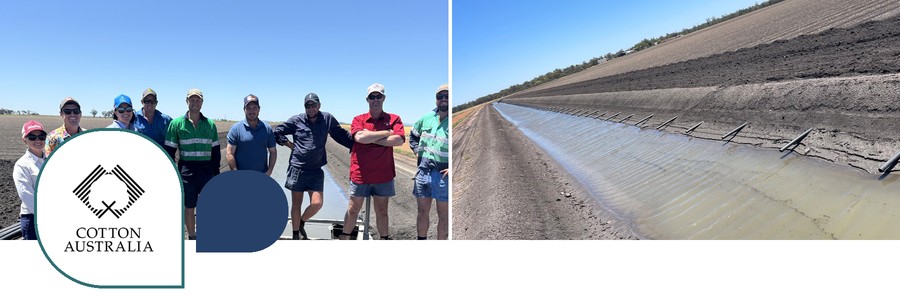
Dawson Valley cotton growers are improving water use efficiency following a trip to the Darling Downs two years ago to see first-hand how other irrigators were adapting irrigation systems to better suit their farms.
Funded by a grant from the Queensland Department of Primary Industries Peer-to-Peer Water Quality Program, the tour provided members of the Dawson Valley Cotton Growers’ Association with the opportunity to speak directly with growers who had already implemented water management changes. They were able to discuss costs, benefits and practical challenges, and see how different systems worked in operation.
Dawson Valley CGA president Andrew French said the main value of the program was learning directly from other growers.
“You get way more out of talking to somebody who’s tried something, asking how it actually works and how they did it – it’s the best way to learn,” Mr French said.
A key focus of the trip was pipe-through-bank irrigation, where siphons are installed through the head drain bank to deliver a more even flow of water to each row. Growers inspected a machine developed on the Darling Downs that installs siphons quickly and accurately, using laser levelling to place them at the correct height.
Mr French said the system offered a practical and cost-effective way to improve existing siphon layouts, particularly where full bankless systems were not suited to the landscape, water supply or business needs.
“It’s a really impressive system – it’s probably the easiest and cheapest way to convert to more automated irrigation if you’ve got existing siphon irrigation already,” he said.
Since the tour, one Dawson Valley grower has bought a machine and begun converting his farm to pipe-through-bank irrigation. Along with water efficiency gains, the change has delivered major labour and time savings and reduced erosion.
“Instead of stopping and starting 100 pipes, you can just open and shut a gate and go home – it makes it a bit easier to get out of bed at 3am,” Mr French said.
“And because the siphons are all on zero grade, you’ve got an even flow coming out of each siphon, reducing erosion and sediment runoff.”
Mr French plans to adopt the same system on his own farm and said other Dawson Valley growers are also considering conversion when they next upgrade their siphons.
The tour also exposed growers to other approaches, including bankless and overhead sprinkler systems, reinforcing that there is no single solution for every farm.
For the Fitzroy Basin, the project shows how practical, grower-led learning can support better water stewardship by helping irrigators identify systems that improve water efficiency, reduce runoff and sediment movement, and contribute to healthier waterways.
…the siphons are all on zero grade so you’ve got an even flow coming out of each siphon, reducing erosion and sediment runoff.